



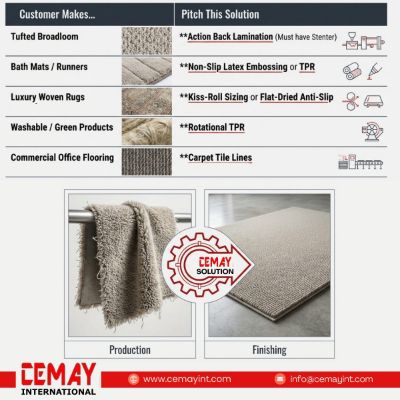
A carpet backing solution is chosen by what the carpet will be sold as, not by how it was produced. A broadloom and a bath mat can come off the same tufted construction and still want opposite things from their backing — one wants dimensional stability, the other wants grip.
Which solution for which product type?
| Product | Solution | What the line must have |
|---|---|---|
| Tufted broadloom | Action Back lamination | A stenter is mandatory |
| Bath mats / runners | Non-slip latex embossing or TPR | Embossing rollers or a TPR unit |
| Luxury woven rugs | Kiss-roll sizing or flat-dried anti-slip | Precise add-on control |
| Washable / green products | Rotational TPR | A rotational TPR unit |
| Commercial office flooring | Carpet tile line | A carpet tile line |
What is Action Back lamination for?
For tufted broadloom. A secondary backing gives the carpet its dimensional stability, and the lamination process requires a stenter — which is the first condition the line has to meet when this solution is chosen.
Non-slip latex embossing or TPR?
On bath mats and runners either option produces grip. Latex embossing textures foamed latex with patterned rollers, creating a non-slip surface integrated into the carpet itself. TPR is a thermoplastic rubber layer instead. The choice follows whether the product has to be washable and what handle is wanted.
When is kiss-roll sizing preferred?
On luxury woven rugs. The aim there is not a thick backing layer but transferring an exactly calculated chemical weight to the fabric, which is what kiss-roll delivers. The alternative is a flat-dried anti-slip application.
Why rotational TPR on washable carpets?
Rotational TPR applies molten thermoplastic rubber; the result is an odourless, eco-friendly, machine-washable rug backing. The washable and "green" segment wants those three properties together, which is what settles it on this solution.
What does commercial office flooring require?
A carpet tile line. Carpet tile is its own product format and is produced on its own line, which calls for heavy-duty rigidity.
If your production sits on one of those rows, the units your line needs are largely settled with it. For the differences between the constructions see the three pillars of carpet production, and for the materials themselves see latex, TPR and PVC. To reach a suggested line in a few questions, use the Product Finder.
Frequently Asked Questions
What is Action Back lamination?
It is the application of a secondary backing to tufted broadloom carpet. It gives the carpet its dimensional stability, and the lamination process requires the line to have a stenter.
How is a non-slip carpet backing achieved?
In two ways: by latex embossing, where foamed latex is textured with patterned rollers, or by applying a TPR (thermoplastic rubber) backing. Both produce a durable, high-friction surface.
What backing should a washable carpet have?
Rotational TPR. Molten thermoplastic rubber is applied, and the result is an odourless, eco-friendly and machine-washable rug backing.