



A carpet backing coating does three things: it gives the fabric technical properties, it holds the carpet dimensionally stable, and it creates a non-slip gripping surface. Which material and which application technique you use decides which of the three comes to the front.
What technical properties does coating add to a carpet?
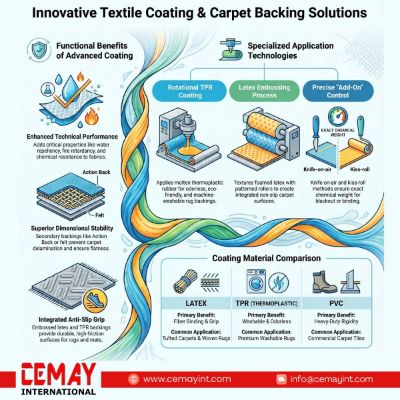
- Enhanced technical performance — adds critical properties such as water repellency, fire retardancy and chemical resistance to the fabric.
- Superior dimensional stability — secondary backings like Action Back or felt prevent carpet delamination and ensure flatness.
- Integrated anti-slip grip — embossed latex and TPR backings provide durable, high-friction surfaces for rugs and mats.
What is rotational TPR coating?
It applies molten thermoplastic rubber. The rug backing it produces is odourless, eco-friendly and machine-washable — exactly the set of properties the premium washable rug segment is after.
How does latex embossing create a non-slip surface?
Foamed latex is textured with patterned rollers. The grip is not added as a separate layer; it forms integrated into the carpet surface itself.
What is the difference between knife-on-air and kiss-roll?
Both are methods of precise "add-on" control — they pin down the exact chemical weight transferred to the fabric. Where a job needs full opacity, as with blackout, or only fibre binding, these are what make the weight hold. Knife-on-air coats the fabric over an unsupported span; kiss-roll meters the transfer over roll contact.
How do you choose between latex, TPR and PVC?
| Latex | TPR (thermoplastic) | PVC | |
|---|---|---|---|
| Primary benefit | Fibre binding and grip | Washable and odourless | Heavy-duty rigidity |
| Common application | Tufted carpets and woven rugs | Premium washable rugs | Commercial carpet tiles |
Find the solution matching your product type across five scenarios in how to choose a carpet backing solution, and see our lines on the Carpet Backing Coating page.
Frequently Asked Questions
What is a TPR carpet backing?
It is a carpet backing based on thermoplastic rubber. Rotational TPR coating applies molten thermoplastic rubber, and the backing it produces is odourless, eco-friendly and machine-washable.
What is the difference between latex and TPR?
Latex's primary benefit is fibre binding and grip; it is used on tufted carpets and woven rugs. TPR's primary benefit is being washable and odourless; it is used on premium washable rugs.
Why does add-on control matter?
Knife-on-air and kiss-roll methods pin down the exact chemical weight transferred to the fabric. Where a job needs full opacity, as with blackout, or only fibre binding, hitting that weight depends on them.